Grants: Frequently Asked Questions
We are happy to answer any questions you may have. Some common questions include:
Details on grant reporting are outlined in your grant contract.
For grants made prior to December 31, 2022 please submit reports through the eGrant portal.
- User Guide for eGrant portal
- If you do not remember your eGrant account information, click HERE.
For grants made after January 1, 2023 please submit reports through the GOapply portal.
- User Guide for GOapply portal
- Login with your email. A “Forgot Password” link is available if you are having trouble logging in.
Additional details can be found HERE. Please contact grants@conncf.org with questions or for assistance.
How do I know if I qualify to apply for funding?
We support 501(c)(3) nonprofit organizations and organizations with a fiscal sponsor who support communities living in 21 towns within Greater Waterbury and Litchfield Hills. For further information visit our Grantmaking Overview (https://conncf.org/supporting-nonprofits/grantmaking-overview/).
What if my organization doesn’t have 501(c)(3) status?
We will consider requests from charitable programs that have a 501(c)(3) organization serving as a fiscal sponsor. The organization serving as the fiscal sponsor must demonstrate solid fiscal and administrative capability.
What if my organization is based outside of the region that the Connecticut Community Foundation serves, but our project focuses on and has participants that live in the region?
The Foundation offers support to organizations outside of our service area as long as the project is focused on impacting residents in our 21-town region. If you are applying for a grant as a statewide agency or for a statewide program, please include detailed information in your application about the number of people served and the intended outcomes and impact that will happen within our service area. It is also important that any organizations out of our region establish connections and develop partnerships in our community so that the work is informed by residents of our towns.
There are various community foundations serving Connecticut. If you are interested in learning more about these funders and which towns they serve, please click HERE.
Is it worthwhile for us to apply for a grant when I was previously denied?
This may depend on various circumstances such as the amount of time that’s passed between requests, reason specified for denial, resources currently available, etc. Please contact the relevant program officer (listed HERE) to discuss potential re-submission.
Do you have an anti-hate grant policy?
Yes. Connecticut Community Foundation will not accept funds from donors or make contributions to grantees that the foundation believes, in its sole discretion, are intended to support or engage in hateful activities, whether online or offline. To view the foundation’s anti-hate policy, click HERE.
Does my project fit the Foundation’s funding priorities? How do I choose a priority area for application?
Our website is the best place to start learning about our funding priorities. Deadlines and guidelines for all of the grant programs can be found HERE. We do prioritize organizations aiming to reduce disparities and improve outcomes for diverse communities within the Greater Waterbury and Litchfield Hills region. As noted below, you are also welcome to contact staff to discuss the most appropriate fit for your request.
Can I submit a proposal for equipment?
Grants for equipment-only are limited, although sometimes program-related equipment is included as part of a program grant request. As such, please discuss your specific equipment need with us before submitting a request and be sure to include at least one bid or quotation with your proposal.
Grant proposals for organizational technology projects are also accepted through our Strengthening Nonprofits grant round, which is offered twice a year.
Can I submit a capital campaign request?
Yes, although support for capital campaigns is limited. Please discuss with a member of our program staff prior to submitting a funding request.
Can I submit proposals for organizational development work?
Yes. All organizational development requests can be submitted to our Strengthening Nonprofits Grant. Proposals can include, but are not limited to, strategic planning consultants, fundraising assistance, new technology, one-on-one coaching, work focused on diversity, equity and inclusion and other projects designed to help build organizational efficiencies and increase overall effectiveness.
How many proposals can I submit in a grant round?
Nonprofits can submit a request to each separate priority area per round. For instance, if you are applying for a Building Equitible Opportunity grant you are still eligible to apply for a grant in another issue area such as Strengthening Nonprofits or Pathways for Older Adults.
Typically, organizations may submit one grant proposal per priority area per grant round. If you would like to submit more than one proposal within a priority area, please discuss it with our program staff first.
Can I apply for funding outside of the Fall and Spring grant periods if it is an urgent request?
Yes. There may be limited discretionary funds available that can be explored. We highly encourage a conversation with a program officer about this type of request.
What is a grassroots grant?
A grassroot grant is a grant available for Waterbury residents who would like to make positive neighborhood change. Applicants do not need to have 501(c)(3) nonprofit status and can use a fiscal sponsor (see eligibility section above for more information on fiscal sponsorships). Learn more about our Grassroots Program by reviewing the grant guidelines.
What is the average grant amount?
The average amount is between $5,000 and $15,000. Grants for larger amounts can be considered. However, for those, please contact our staff to discuss the project in advance of submission.
What kinds of items can be included in the budget?
Direct Costs: These expenses are directly related to completing the grant deliverables. They may include staff time, equipment or materials, marketing, or outside services required.
Indirect Costs: These are overhead expenses. They may include rent and utilities, general and administrative expenses, and publicity and fundraising.
The foundation typically funds direct costs. Organizations are also encouraged to include indirect/overhead expenses, and the budget allows for a flat 10% for this purpose (it may be higher, with additional explanation).
Why does the grant application and subsequent report collect demographic information for staff, board members, and population being served?
Connecticut Community Foundation has embraced a strategic direction, grounded in data and informed by community input. We have determined as an organization that, in order to be effective and have the greatest impact, we need to pursue equitable and just outcomes aimed at reducing disparities. As such, we encourage our nonprofit partners to take stock of their organizational leadership and to consider if it is reflective of the community that it serves. (The Foundation, being in the midst of its own organizational journey, humbly recognizes that this process can take time.)
Who decides the approval or denial of grant requests?
Connecticut Community Foundation believes that individuals who live in and reflect our region are best poised to determine viable solutions for issues impacting our community. We have volunteer grant committees, guided by our program staff team and chaired by members of our board, who review grant requests and make recommendations for our board of trustees to ultimately decide on.
Is it likely that we could be funded for 100% of the cost of a proposed project?
It is possible, especially if it is a smaller project. However, given the foundation’s finite funding resources, additional funds and in-kind contributions from other donors or organizations are often necessary to complete the project budget, especially with larger efforts.
When will I hear about the status of my application? If approved, how soon will funds be dispersed?
The foundation will notify grantees within a week of final board decisions. Funds will be dispersed via check or electronically (ACH) usually within the same week the award is officially accepted by the grantee.
How do I create a grants account?
Connecticut Community Foundation uses an electronic grant application system called GOapply. All organizations will need to create a new account this system for 2023.
Find details for getting started in GOapply in our user guide and through our instructional videos.
- If you have not yet created GOapply account, you will need to create one HERE.
- Registration requires verification and approval.
- Login with your email. A “Forgot Password” link is available if you are having trouble logging in.
- If you need any assistance with the GOapply portal, contact grants@conncf.org
Where can I find funding opportunities and applications?
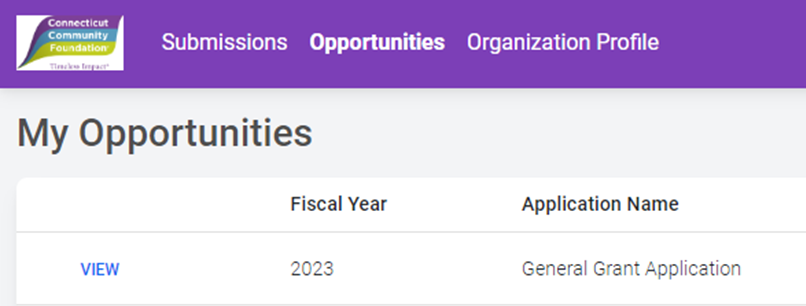
Once your registration has been approved, login to GOapply and select the Opportunities tab to view a list of funding opportunities currently available.
Click the View link to select a funding opportunity.
From within the application page, click the Apply button to begin an application.
Are sample applications available?
Yes, sample applications are available HERE. We encourage you to review samples in preparation to complete the applications online.
Can I save my application if I need to complete it at a later time?
Yes, you can manually save your application at any time by clicking the Save Draft button on the bottom left of your screen.
If you are stepping away from your computer, be sure to manually save before you leave. Otherwise, the website will eventually time out, which may cause you to lose completed information on the current page.
Can multiple people in my organization contribute to our grant application?
Yes, multiple people in your organization can register in GOapply and work together to complete a grant application. Registrants will be linked to your organization account and will be able to share access to draft applications and view past applications submitted through GOapply. Applications and reports submitted prior to 2023 on our previous eGrants portal will not be available in GOapply (although they can still be accessed in eGrants for the time being).
Can I speak with someone at the Foundation for more support?
Certainly! We encourage an initial conversation with one of the Program staff (listed HERE) to explore potential grant requests. This conversation can help to determine your organization’s eligibility and to learn more about the foundation’s priority areas, including which one would be most appropriate for your request.
Not all inquiries move beyond this initial conversation. Requests that are discouraged at this stage will be notified of the reasons for discouragement. In some cases, staff may be able to direct you to other resources.